
The truth about homeopathy - principles and effectiveness
Homeopathy is perhaps the most controversial, yet most popular, form of alternative medicine. Some oppose it, while others swear by its power and effectiveness.
And since the scientific method is the best way to understand whether something related to medicine has an effect, in this article you will discover what the largest and most reliable studies on the subject show.
Read more to find out:
- Does homeopathy work and what are its principles?
- How did it become what it is today?
- What can modern medicine learn from it?
Principles of homeopathy

First principle of homeopathy
According to the European Committee of Homeopathy, the first principle of homeopathy is "like cures like" or Similarities are cured by similar things. (Latin). Based on it, homeopathic medicines usually use ingredients that cause symptoms similar to those you want to cure. [1].
In practice, this means that fever remedies can, for example, be made from belladonna, which also causes fever. A mixture based on bee venom is used to treat itchy swellings, etc.
In fact, the very name homeopathy, coined by its creator Samuel Hahnemann, comes from the Greek words for „like suffering.“ This refers to the principle of treatment that „like cures like.“.
According to “The School of Homeopathy” – one of the official world homeopathic organizations, this principle acts as a stimulus for the body’s natural response. Through this principle, your body receives the necessary stimulus to deal with the problem and a healing response is triggered. [2].
Furthermore, according to them, the science-based medicines used in medicine only suppress symptoms by masking them. This is how homeopaths explain why sometimes you have to stay on medication for a long time and your symptoms return when you stop taking them.
According to homeopathy, the body's defenses are "stagnant" during the disease process. Therefore, homeopathic medicines do not suppress symptoms, but stimulate the body to overcome the problem.
The principle that like cures like is fundamental to homeopathy and every homeopathic product adheres to it in some way. At first glance, it may seem that some products do not adhere to the principle, but in fact it is important to look at the history of each remedy.
For example, the drug Oscillococcinum from the manufacturer Boaron is made from duck liver and heart. [3]. It is available in pharmacies as a medication to treat infections such as the flu.
The creator of Oscillococcinum, Joseph Roy, claimed that during the Spanish flu epidemic in the early 19th century, he isolated a bacterium he called Oscilococcus from sick patients. [4]. Roy never presented evidence for his discovery.
He claims to have isolated this bacterium by some chance from patients with many other diseases, as well as from some animals such as ducks.
Therefore, he chose duck organs as the basis for his medicine, based on the principle of "like cures like.".
To date no other scientist has been able to isolate the bacterium in question from any patients or animals. Furthermore, we now know that the Spanish flu was caused by a virus, not a bacterium or other pathogen [5].
Second principle of homeopathy
The second principle of homeopathy is the special preparation method called potentization. [6]. The idea is that diluting and mixing the ingredients somehow activates their healing powers and enhances their effects.
For this purpose, the ingredient is dissolved in alcohol or distilled water.
Homeopaths take one part of the solution and mix it with nine parts of water, diluting it to one-tenth of its original concentration and shaking it.
Vigorous shaking is an important element of preparation, as according to homeopaths, this is how the substance imparts its "essence" to the water.
The result is a potency of 1X – one part ingredient and nine parts solvent. The potency is denoted by the Roman numeral X, for 10. Alternatively, some manufacturers use the letter D.
This process is repeated many times. If you take one part of the new mixture, mix it with nine parts of clean water and shake it vigorously, you now have 2X.
This is done over and over again until the desired potency grade is achieved. The finished medicine is then taken orally. It is sometimes administered in the form of small sugar balls, which are sold as globules.
There are also homeopathic creams, as well as suppositories, which are oil-based and are applied rectally.
Regardless of their form, homeopathic medicines usually offer a potency much higher than 1X or 2X.
For example, one of the most common - 20X potency - is such a high dilution that it is equivalent to dissolving one aspirin pill in the water volume of the entire Atlantic Ocean.
Many potencies are more extreme, such as 30C. Here, the symbol “C” means that the mixture has one part ingredient and 99 parts water, i.e. 1 to 100, not 1 to 10 as with X or D.

Problems with the principles of homeopathy
Is the active substance(s) still there?
The idea behind potentization is that extreme dilution makes the ingredients stronger, but on a physical level, this doesn't make sense. In fact, most homeopathic remedies are diluted so much that there isn't a single atom of the active ingredient left in them.
For example, a homeopathic remedy 30C contains one part of the original ingredient to 1,000,000,000,000,000,000,000,000,000,000,000,000,000,000,000,000,000,000,000,000,000,000,000,000,000,000,000,000 parts of water.
Scientists have calculated that if you were to assume a globule containing at least one atom or molecule of the original ingredient, its size would be 150,000,000,000 kilometers in diameter.
Such a pill would be so massive that, according to the laws of physics, it would collapse into a black hole under the influence of its own mass.
In addition, more extreme dilution methods are also applied, such as the Korsakov method, which is denoted by the symbol K. [6].
In this method, the tube is literally rinsed repeatedly of the original active substance. Homeopaths assume that after each rinse, a particle or so-called “essence” of it remains on its walls.
The dilution for Oscillococcinum is 200K. This means that the tube was rinsed 200 times with the duck organ extract.
The water is then mixed with sugars (sucrose and lactose) used as a base to make small pills.
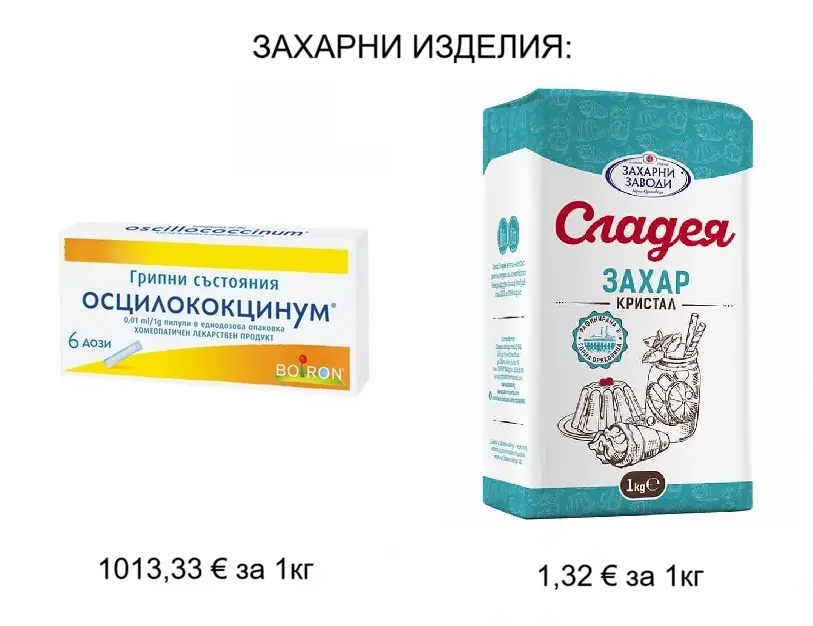
The pills are sold in every pharmacy, the price of this homeopathy is over 1 euro per dose (each dose is 1 gram). So the price for a 6-day course swells to over 20 euros, given that you have to take a dose every 6 hours according to the leaflet.
This is an important problem, also addressed by one of the first critics of homeopathy in Bulgaria, namely Acad. Prof. dhn. Ivan Yuhnovsky, long-time chairman of the Bulgarian Academy of Sciences (1996 – 2008).
In your book „"Homeopathy Today" (2022) He collects and discusses the basic claims of homeopathy and their conflicts with principles of chemistry and physics.
The following comparison, still relevant in 2026, is also borrowed from his book:
Contradiction between the two principles
Besides the role of dilution or so-called potentization being to increase the strength of the medicine, the European Committee of Homeopathy shares that in this way possible toxic properties are eliminated. [6].
For this reason, homeopathic medicines are said to achieve an exceptional safety profile.
But this in turn contradicts the first principle that „like cures like.“ It is the toxic effect of the active ingredient that mimics the symptom of the disease we want to improve.
If the effect that mimics the symptom is no longer there, how will the homeopathic medicine stimulate the body to cope with the disease condition on its own?
Homeopathy's explanation for why the mixtures still work is that shaking (succussion) the mixture after each dilution leaves behind a spirit-like "essence" of the ingredient.
When the solvent is water, for example, homeopathy assumes that it “remembers” what was put into it. [7].
But if this were true, then every substance that ever encountered a drop of water would leave an “essence” behind. And this would lead to unpredictable effects if accidentally ingested.
Think of all the things that live and swim in the oceans. Every sip of water would be a energizing homeopathic cocktail.
Of course, nothing like this happens in reality, and there are no physical principles that could explain it.
Scientists only report the possibility that dissolved substances can affect the hydrogen bonds between water molecules. But this “memory” lasts no more than 0.000000000001 seconds after dilution. [7].
In other words, by taking a homeopathic medicine, it Depending on the dilution, you are most likely not taking a single molecule of the substances listed on its leaflet as active ingredients.
The rise of homeopathy
So how did homeopathy become the most successful alternative medicine of our time?
Homeopathy was created in the 18th century, when medicine was very different from today.
One of the most common forms of treatment at that time was still bloodletting, although after the procedure the patient was often in worse condition than before.
Therefore, the German physician Samuel Hahnemann wanted a non-invasive and natural way of treating diseases. For this reason, he developed the two basic principles that we have already discussed in detail and created homeopathy.
And in reality, homeopathic hospitals soon achieved success because doing no harm was a much more successful strategy than applying dangerous and harmful manipulations.
In addition to applying the two basic principles of homeopathy in the development of his medicines and treatment methods, Hahnemann also imposed very strict rules on his patients. These are described to this day in his "Organon of Medicine" and "The Art of Healing".“ [8].
First, coffee, tea, alcohol, spicy foods, sweet foods had to be avoided. No mature cheese, no onions, no meat. No sheep's wool clothing.
No napping, no games, no masturbation, and of course, no reading pornographic texts and much more.
But also no sedentary work, no sitting in stuffy rooms, no warm rooms, no horseback riding, and other strenuous activities.
Then and only then, according to the inventor of homeopathy, will his medicines work.
Of course, all these instructions are not talked about today, except for those that make some sense – rest and airing the rooms.
To date, only that which remains of the principles of homeopathy that patients would be most inclined to trust and believe.

How do we know if homeopathy works?
To find out if a medicine works, even if it is homeopathic, the surest way is to conduct a study in humans (clinical trial). It is important that the patients are randomly assigned to groups (randomization), and one of them is the control group, receiving a placebo (placebo-controlled).
This ensures that you are proving a causal relationship. Other types of studies that are in humans but lack a placebo and/or randomization cannot be used as evidence of the effectiveness of any medication. These include, for example, epidemiological studies.
A placebo is well known as an “empty pill.” That is, it has no active ingredient, but it can still affect how a patient feels, simply because they believe the pill can help them. [9].
Animal studies or in vitro, which are generally called laboratory tests, have an even lower level of evidence. Often their results have nothing to do with the actual effect of the medication.
Their role is actually to be the initial step in the development of a drug - long before it reaches the pharmacy.
Therefore, when we have a product that has already reached the market, it is important to focus on the results of clinical randomized and placebo-controlled trials.
Moreover, we need to check whether there are enough such studies to confirm or reject the effectiveness of the medication, whether they are unanimous, and what is the risk that they have been manipulated.
This is precisely what is done in systematic reviews and meta-analyses, which summarize information from all studies to date, evaluate them, and analyze the final results.
What does science say?
Cochrane is one of the most authoritative scientific organizations in the world. They are known for being independent and striving to impartially evaluate, analyze and summarize all scientific data on a given topic.
They conducted a meta-analysis published in 2018 on the available scientific evidence on the effectiveness of homeopathic medicinal products for respiratory infections in children. [10].
The analysis included a total of 8 studies and 1,562 children and revealed that there was no reliable evidence that homeopathic medicines help with respiratory illnesses in this age group.
An even larger meta-analysis was conducted in 2017, which included 75 randomized clinical trials of homeopathic medicines for all conditions. [11]. The analysis shows that only 3 of the studies conducted with homeopathy can be classified as reliable.
The researchers found that 23 of the studies were of unknown reliability, while the remaining 49 studies were of low quality, poorly designed, and/or at high risk of being manipulated.
Excluding data from the weakest studies, as well as those for which the full set of data is not available, the scientists concluded that the effectiveness of homeopathic products is no higher than placebo.
What do regulators say?
Global drug and regulatory organizations also emphasize that there is no convincing evidence of any effect of homeopathic medicines beyond placebo.
For example, the US Food and Drug Administration (FDA) reports that homeopathic products are not approved and are not subject to evaluation for safety or effectiveness. [12].
Additionally, the organization is concerned that homeopathic products may be dangerous for some patients, particularly those who plan to use them for serious medical conditions or as a substitute for proven medications.
How are things in Europe?
For the purpose of control, the European Medicines Agency (EMA) has established and manages a regulatory framework for homeopathic products called the Working Group on Homeopathic Medicinal Products (WGHMP).
Within the European Union, homeopathic products are subject to special regulations that cover only the quality and safety of the products, with respect for national traditions in homeopathy.
But even in the EU, homeopathic products are not regulated for their efficacy, unlike standard pharmaceutical medications.
They go through a so-called specialized approval process, which is easier and simpler and does not require clinical evidence of effectiveness, which is mandatory for other types of drugs.
The EAL approach focuses only on the safety and traditional use of products, with the emphasis on the quality of production and preservation of the national traditions of different countries, rather than on clinical efficacy.
One of the conditions for homeopathic products to be registered at all using this facilitated mechanism is that no specific therapeutic indication must be stated on the label or in any information related to the product. [13]. The same is stated in The Law on Medicinal Products in Human Medicine, in force since 13.04.2007.
According to the cited EU directive, in order to claim therapeutic indications, homeopathic medicines must undergo placebo-controlled clinical trials similar to real medicines. For medicines, this includes 3 phases of clinical trials that prove not only safety but also effectiveness against placebo.
However, in all EU countries (except Spain), homeopathic products are again exempted and approved with the status of medicines, despite the absence of clinical trials at all or, as in the case of Oscillococcinum, even clinical studies by the manufacturer show INEFFICIENCY compared to placebo.
Why do homeopaths claim that after all there is evidence for the effectiveness of homeopathy?
According to the Homeopathic Research Institute, the answer to the question of whether individualized homeopathy works is a resounding “yes.” The organization cites two systematic reviews that included only randomized clinical trials. [14].
The two systematic reviews were conducted by researchers at the institute and included all available randomized clinical trials. They examined the effect of individualized homeopathic therapy versus placebo, respectively. [15], as well as other treatment methods [16].
But when you open the studies in question and examine the results and conclusions of the authors in detail, you will find that the researchers actually claim otherwise.
It turns out that the authors point out that the effect of individualized homeopathy is rather unclear, and the quality of over 60% of the studies to date is poor.
The first review found “small” effects of homeopathic treatment in only a subset of the studies. This should come as no surprise, given that the selection was made by scientists working and funded by the Homeopathic Institute.
However, the review concludes that given the low quality of the studies, no firm conclusions should be drawn. [15].
The second review even reports that there is not a single reliable clinical trial comparing homeopathic treatment to any treatment other than placebo. [16]. Accordingly, conclusions regarding the effectiveness of individualized therapy cannot be drawn.
Furthermore, homeopathy often relies on studies that are not placebo-controlled and therefore do not take into account the placebo effect, or are not conducted on humans at all.
In fact, most studies of homeopathic medicines are conducted only in laboratory settings. These are the studies most often cited by most homeopaths.
It should be kept in mind, however, that they cannot in any way prove the effectiveness of any medication.
Moreover, although most of the results of laboratory studies regarding homeopathy are positive, they often cannot be reproduced by other scientists.
Why is homeopathy still so popular today?
Medicine has changed a lot in the last 150 years.
Currently, life expectancy is the highest in human history, and this is largely due to the new tools that modern medicine has developed.
These include modern diagnostics, double-blind randomized trials, and scientific verification methods.
Thanks to these tools and all the scientific research to date, scientists know that homeopathy has no effect beyond placebo.
But even if that's the case, who cares why it works if there are still people who claim it helps them?
Maybe you've tried it and felt better? Many people take homeopathy for coughs, sore throats, nausea or vomiting, and other problems, and experience relief within a few days, and sometimes within hours.
And you may know someone who has overcome a serious illness while using homeopathic remedies.
There are also many reports, both from unqualified persons and from doctors, that it works not only on adults, but even on children and animals. How is it possible that this is just a suggestion?
These examples are most likely due to the placebo effect or the fact that most causes of the most common complaints in everyday life such as a runny nose, cough, stuffy nose, and fever are self-limiting.
Let's look at the placebo effect in detail, and why it exists even in animals.

What is a placebo effect?
The placebo effect is very real, not a matter of imagination or suggestion. Studies comparing placebos with „nothing“ – that is, patients taking no medication at all – show that placebos have a significant clinical effect on their complaints and symptoms. [17].
And this happens even though the placebo itself contains nothing. What's more, studies have shown that the placebo effect can be effective in most clinical conditions, with symptoms of nausea and pain being the most affected. [18].
No matter how smart and skeptical you are, you are not immune to the placebo effect. If people believe, or at least assume, that something will help them feel better, the belief itself leads to the desired effect. But what is affected in this case is only the symptoms.
And it has been proven that the placebo effect can be transferred. Children and animals rely on their parents or owners and feel their emotions. If the parent has faith in a treatment, this can affect the child as well. [19].
The phenomenon has also been observed in animals, who react strongly to the body language of the people caring for them. [20].
But homeopathy's most powerful tool is time. The human body is a survival machine. For example, most infections go away on their own within a few days.
If you take a medicine when you're already feeling bad, and then you start to feel better, you feel like it really cured you. And in fact, that's what would have happened anyway.
This is why the most popular homeopathic medicines are advertised for self-limiting conditions like colds. These are illnesses that go away without treatment. [21].
The most commonly used are homeopathy for colds, coughs, sore throats, stuffy noses, fevers, vomiting, etc. All of these symptoms usually go away without treatment.
The place of homeopathy in modern medicine
Homeopathy likes to play the role of a gentle alternative to the big pharmaceutical industry, also known as Big Pharma.
But the homeopathic industry is also Big Pharma.
Homeopathy is a huge pharmaceutical industry and billions of dollars are being made at an extraordinary rate.
Keep in mind that practically nothing is added to homeopathic products, and then they are sold at prices that are even higher than proven medicines.
In addition, the homeopathic industry has its own lobbying organizations and fights extremely hard against people who oppose it or try to refute its effectiveness. After all, a lot of money is at stake.
Expected in 2026the global market for homeopathic products to reach around 13 billion euros.
Some critics even argue that the homeopathic industry is harmful to public health because it creates distrust in proven medicine. And rightly so.
Homeopathy can discourage people from seeking the help they need when their lives or those of their children are at stake.
But there is actually one key to homeopathy's success that all of us medical professionals could and should copy. The first consultation with a homeopath can take hours and is very personal.
For a patient who has already been on a seemingly endless journey from doctor to doctor, this level of attention and empathy can make a huge difference to their well-being, even if the conversation was not the point of the therapy.
Why is this happening? Because the idea of modern medicine is to be as efficient as possible for the maximum number of people.
It saves millions of lives every year. But it is also a tightly organized system. Limited budgets force doctors and nurses to deal with many patients.
Consultations should be time-efficient, diagnoses should be made promptly, and treatment should be quick and widely available.
Unfortunately, there is no time left to pay special attention to each individual. And this can make patients feel invisible, scared and abandoned.
Here's what modern medicine can learn from homeopathy. It answers a human need that has gone unmet.
We need to find time for the individual again. To look at people, not numbers.
But as important as empathy is, it is no substitute for real healing. Faith can move mountains, but sugar pills cannot cure diseases.
If you found this article helpful, feel free to follow me on social media for more evidence-based content.
11 thoughts on “Истината за Хомеопатията – същност, принципи и ефективност”
Thanks for the structured information. I am one of those people who, on the recommendation of my children's pediatrician, does not use homeopathy. However, lately I feel like a dinosaur because of it, and here I found the facts to share when explaining why homeopathy does not cure.
I'm glad the article was useful to you!
Your statement that indications cannot be written on the packaging of homeopathic medicines and that this is circumvented in Bulgaria is completely false. Homeopathic medicines can be approved under 2 different procedures, those that do not have indications (monopreparations) and those that do (specialties). The latter can contain information about their action and application, including symptoms. This is in full compliance with Bulgarian and European legislation and is valid for the entire EU. Monopreparations are small tubes with granules and names in Latin. Specialties are syrups, tablets, drops and other dosage forms that are authorized for use for certain indications and dosage regimens.
Hello, I am quoting European legislation. If Bulgarian legislation says something different, then please cite your source and I will be happy to edit the text. I searched European legislation and did not find a law that allows the writing of "efficacy claims", which is logical considering that such cannot be proven. If you have an example from European legislation that allows similar claims by homeopathic pharmaceutical companies, please share and I will edit the text again.
LLPHM Art. 36 – Authorization for use of a homeopathic medicinal product – a homeopathic medicinal product under this article follows the provisions of Art. 27-32.
Ordinance No. 38 of September 13, 2007 on the requirements for data on the packaging and leaflets of medicinal products – Art. 13, para. 2. – all requirements are in force as for a normal medicine, if it is not authorized under a simplified procedure (monodrug), that is, under Art. 35 of the LLPHM.
Please note Article 3, point 15.
Article 16 of 2001/83/EC – procedure for authorisation of a homeopathic medicinal product other than one under Article 14 (monopreparation).
Again, I will briefly explain. The European and Bulgarian legislation regarding the requirements for homeopathic medicinal products is absolutely identical. There are 2 procedures. A simplified registration procedure (Article 35), which is used for a monopreparation without specific therapeutic indications. The key word is registration. There are no indications for action and application and no doses. It does not say what it is for. The second procedure is a procedure for authorization to use a medicinal product (Article 36) - these are products that meet all the requirements as for ordinary medicines. The key word is authorization to use. They have a summary of the characteristics, a leaflet, a secondary packaging. They have indications and doses, intake, age, etc. These are the so-called specialties. They are tablets, creams, drops.
The law does not mention monodrugs and specialties anywhere. This is a fabrication by Boiron and other similar fraudulent companies.
I'll explain briefly, because you clearly didn't read the article well - in the article itself I already wrote that if the manufacturer wants to make claims about effectiveness or indications, then instead of the simplified procedure, it must go through the classic procedure for approving a medicinal product. And I've quoted the law very clearly with links.
The controversy is that according to you, drugs like Oscillococcinum, for example, have gone through the full procedure, but they HAVE NOT. You clearly do not understand what this procedure is, so I will briefly explain again – the procedure for approving a REAL drug goes through THREE phases of testing:
Phase I: Small studies in healthy volunteers to assess safety, tolerability, and pharmacokinetics.
Phase II: Limited clinical trials in patients to initially evaluate efficacy and safety.
Phase III: Large trials to confirm effectiveness, monitor side effects, and compare with other treatments, gathering key information to apply for approval.
Please share where these studies proving effectiveness are when we talk about homeopathic preparations? If you are looking for them for Oscillococcinum, for example, let me make it easy for you: here are all registered studies in the EU / EAL and only one Phase 3 study (EudraCT Number: 2013-001869-16) has been registered, the results of which reveal the following: THE STUDY WAS TERMINATED EARLY AFTER THE INTERIM ANALYSIS DUE TO THE INABILITY TO ACHIEVE THE EXPECTED BENEFIT. The study only shows safety. that's why instead of writing TREATMENT of FLU on the packaging, it says flu-like conditions. In America they have already been sued several times for this.
By the way, the study ends in 2014. And since when has Oscillococcinum been in this packaging and being advertised for flu?
Let's see another one for example – Stodal – there is NOT A SINGLE STUDY for its effectiveness. Come on, prove that it was approved according to the standard procedure – well, no, it is not. These homeopathies are listed in the register of the MEDICINE EXECUTIVE AGENCY only because they have passed a short safety procedure and that's it. And therefore, by law, they should not mention diseases. Technically, they don't, because one says "cough of various origins", and the other "flu-like conditions", whatever that means.
Sir. For years I have been involved in the registration and authorization of homeopathic medicinal products. I know better than you. Homeopathic products do not require proof of efficacy, only of quality and safety. Efficacy is determined only by literary data, which is also the requirement for traditional herbal medicinal products. However, in the eyes of the law, these are medicines. And yes, it is completely permissible to list symptoms and indications, even proven only by literary data, when the product is authorized under Article 36 of the law, which is Article 16 of the directive. I will not argue about something that I have been doing daily in my work for years, and you have simply read it from top to bottom. We are not talking about which works and whether it works. We are talking about the fact that in the legal world these are medicines. And those under Article 36 have exactly the same status as all the others. The only difference is that efficacy is proven only by literary data. It is written very clearly in a number of places. You claim that you can't write indications on the homeopathy box and that in our country it happens because someone turns a blind eye. I explain to you that in our country and throughout the EU, with the exception of Spain, it is the same and such indications are allowed. No one has slept through anything and has not turned a blind eye.
Okay, I edited the part about circumventing the law. So you mean to say that even though in order to have "indications" they supposedly have to go through the full procedure like real drugs, BUT a compromise is still made for them, as there is no need at all for clinical studies showing effectiveness - what's more - there are clinical studies by Boiron himself showing INEFFICIENCY, but the law counts him as having "SUCCESSFULLY" passed the full procedure under Art. 27 - 32? Is that right?
What does literature data mean to you? Literature data may be available from studies with mice, but they cannot be used to judge the effects in humans, which is why clinical studies are needed. It is good if you are dealing with the approval of drugs, to understand the difference, and not simply call all studies „literature data“. The full procedure under Art. 27 – 32 explicitly mentions clinical studies, or can this be interpreted in the law as optional? Could you quote the exact article „that the efficacy is proven only by literature data“.
Yes, I'll point it out right away. ZLPHM, art. 36, para. 2 and para. 3. This type of data is extracts from homeopathic materia medica and repertoriums. Very detailed information on how to proceed with such data is available on the HMPWG website
Wonderful article and very well synthesized! I specialize in general medicine and my whole being internally fights against my mentors who prescribe homeopathy and the parents who claim that it works for their children and seek out the preparations in question. I want to "believe" in order to be useful to the frightened patients, but there is nothing, except the placebo effect described in the article. Hopefully we will be able to satisfy this missing link in traditional medicine so that we don't have to talk hot and cold. This part is very difficult for me...
That's right, thanks for the comment!