Ozempic for weight loss - effectiveness, side effects, costs
Ozempic is a diabetes medication that mimics the function of the hormone glucagon-like peptide-1 (GLP-1), which occurs naturally in the human body and plays a role in regulating appetite and blood sugar (BG).
Specifically, Ozempic is one of the medications containing the peptide semaglutide, which is an analogue of GLP-1 and has a powerful effect on:
- Weight loss in overweight and obese people
- Blood sugar control in type 2 diabetes (T2D)
- Reducing cardiovascular risk in type 2 diabetes
Ozempic positively affects all of these problems by mimicking and regulating the production of various hormones, including several key “satiety” hormones.
Therefore, Ozempic can lead to significant weight loss and its variant called Uegovi is approved by the European Medicines Agency (EMA) as a weight loss therapy for children over 12 years of age and adults.
Therapy with Ozempic is possible only after consultation with qualified and experienced doctor who can issue an electronic prescription and to monitor the treatment.
In this article you will find the most up-to-date information about the efficacy, safety, dosage, and method of use of Ozempic.
What is Ozempic?
Ozempic, as well as Rybelsus and Wegovy, are trademarks of the Danish pharmaceutical company Novo Nordisk.
They are all prescription drugs. only on prescription and contain the peptide semaglutide, which was developed by Novo Nordisk in 2012
Semaglutide is a synthetic (laboratory-made) peptide (a molecule made up of several amino acids).
Semaglutide is an analogue of the natural human hormone GLP-1 (glucagon-like peptide 1) and, like it, is composed of 31 amino acids.
GLP-1 is produced in the intestine (and in small concentrations by alpha cells in the pancreas itself) after a meal and stimulates insulin production but only if sugar levels are high [1].
The structure of semaglutide в Ozempic is 94% identical to that of natural GLP-1, allowing it to bind to the same receptors in the body [2].
However, slight modifications have been made to three of its 31 amino acids. These changes make the molecule much more stable and extend its action – a 7-day half-life. [3],[4].
That is, after one Ozempic injection, about 7 days, to reduce its concentration in the blood by half, and its complete clearance from the body takes approximately 5-7 weeks.
What is Ozempic approved for?
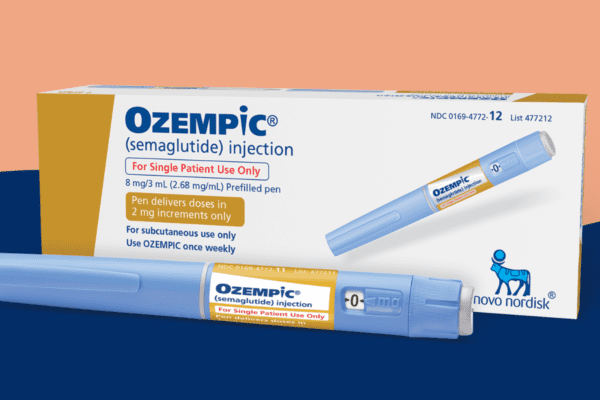
Ozempic is the first semaglutide drug approved for clinical use, which occurred in the United States in 2017.
The U.S. Food and Drug Administration („FDA“) approves Ozempic in doses up to 1 mg per week as a therapy for the treatment of T2DM.
In 2020, the drug was also approved to reduce the risk of cardiovascular events in people with type 2 diabetes, and in 2022, it was also approved at a dose of up to 2 mg per week. [5], [6].
Ozempic has also been approved by the European Medicines Agency (EMA) for use in Europe with the following chronology:
- In 2018, for the treatment and control of CVD in people with type 2 diabetes with doses up to 1 mg per week.
- In 2021, to reduce the risk of cardiovascular events in people with type 2 diabetes.
- In 2023 for the treatment of type 2 diabetes with doses up to 2 mg per week.
Are there Ozempic tablets?
Ozempic is just one of the trade names under which semaglutide is available on the market.
In addition to Ozempic, semaglutide is also available in pharmacies as Ribelssus and Vuegovi.
Semaglutide is the first and only GLP-1 receptor agonist that is also approved in tablet form.
This is the so-called Rybelsus, which was approved by the FDA in 2019 and by the EMA in 2020 for the treatment of T2DM [8]. It should be taken in the morning on an empty stomach to ensure the peptide is absorbed as well as possible.
What are the alternative forms of Ozempic approved for – tablets and higher doses?
The main ingredient in Ozempic, semaglutide, is now available in pharmacies in higher doses as a medication. Wegovy (Whet / Weg / Whig).
Wegovy is also an injectable medication that was approved by the FDA in 2021 for the treatment of obesity in adults with doses up to 2.4 mg per week, and in 2023 – for obese children over 12 years old. [7].
The medication is now available in the pharmacy network in Bulgaria and you can find it here detailed description of Wegovy.
Currently, Ozempic, Ribesus, and Uegovi are available in Bulgaria only by prescription.
How does Ozempic work?
Ozempic works by activating GLP-1 receptors throughout the body, leading to various therapeutic effects.
One of the most notable effects of the peptide is the lowering of blood sugar and improved glycemic control.
Ozempic achieves this by interacting with GLP-1 receptors in the pancreas, which stimulates insulin production and suppresses glucagon production. [3].
Increased insulin stimulates cells in the body to absorb glucose from the blood, thus normalizing blood sugar more quickly after eating.
This effect is glucose-dependent, and insulin is not released unless there is high blood sugar. Because of this, Ozempic does not cause hypoglycemia.
By suppressing glucagon production, this reduces glucose synthesis in the body, and leads to improved fasting blood sugar levels in T2DM.
Ozempic also slows gastric peristalsis in the first hours after a meal by up to 38%. This further reduces the spike in blood sugar after a meal and improves satiety. [9].
How does Ozempic suppress appetite?
The primary mechanism by which semaglutide (Ozempic) reduces appetite is its action on the brain.
It binds to receptors in key areas of the brain, most notably the part called the hypothalamus, which controls hunger. [10].
Specifically, semaglutide activates neurons known as POMC/CART, whose function is to signal satiety. [11].
At the same time, it indirectly suppresses the release of potent hunger-stimulating peptides such as neuropeptide Y (NPY) and agouti-related peptide (AgRP).
In addition, semaglutide also affects hormonal balance related to nutrition.
When you lose weight, levels of leptin (the satiety hormone produced in adipose tissue) drop, which increases hunger.
Ozempic helps counteract this effect. It also stimulates the production of another satiety hormone, Peptide YY (PYY), contributing to a longer-lasting feeling of fullness.
These effects have been proven in clinical studies, according to which taking 2.4 mg of semaglutide per week for 20 weeks resulted in 35% lower calorie intake [12].
In a buffet-style eating experiment, participants on 2.4 mg/day semaglutide consumed an average of 415 calories, compared to 650 calories in the placebo group. [12].
This resulted in an average weight loss of 9.9% in people taking the drug.
Ozempic for type 2 diabetes (T2D)
Ozempic has been approved by both the FDA and EMA as a medication for sugar control in patients with T2DM based on the results of the SUSTAIN (Semaglutide Unabated Sustainability in Treatment of Type 2 Diabetes) clinical trial program.
Specifically, SUSTAIN is a series of trials initiated by Novo Nordisk and conducted to evaluate the safety and effectiveness of Ozempic in patients with T2DM.
The program consists of several phase 3 trials, the last of which (SUSTAIN-11) was published in 2022. [13].
Studies compare Ozempic with placebo and various T2DM drugs – Invokana, Januvia, injectable insulin and other GLP-1 receptor agonists such as liraglutide (known as Saxenda and Victoza) [14], [15], [16], [17], [18], [19].
The results of all studies in the program demonstrate the superiority of Ozempic in terms of lowering glycated hemoglobin (HbA1c) and fasting blood sugar compared to other medications.
Patients with type 2 diabetes taking 1 mg Ozempic weekly achieve a decrease in HbA1c by at least -1.5% when their glycated hemoglobin was above 7% before therapy [14], [15], [16], [17], [18], [19].
Ozempic and kidney problems in type 2 diabetes
FLOW is a major kidney-focused study involving over 3,500 patients.
It included patients with type 2 diabetes and chronic kidney disease, randomized to Ozempic 1.0 mg once weekly or placebo. [20].
The population was high-risk, with impaired renal function and albuminuria, and participants were also on stable standard therapy, including RAS blockade.
The main message of FLOW is that semaglutide slows the progression of diabetic kidney disease and reduces the risk of renal and vascular events.
According to the publication, Ozempic reduced the risk of kidney failure by 24%, of cardiovascular events by 18%, and of death from any cause by 20% compared to placebo.
This makes FLOW a particularly valuable study because it is the first study with GLP-1 agonists specifically targeting kidney health in patients.
How many kilograms are lost with Ozempic?
When using Ozempic for weight loss, the final result on the weight loss depends on several different factors:
- individual sensitivity and starting weight
- diet and physical activity with which Ozempic is combined
- dosage of Ozempik
Studies such as SUSTAIN-7 show that at a starting weight of around 95 kg and in combination with only basic recommendations related to nutrition and activity, patients lose an average of about 6.5 kg in 40 weeks with Ozempic from 1mg [17].
This equates to approximately 71% weight loss with Ozempic from baseline, which is a clinically significant weight loss over this period.
Keep in mind that this is an average weight loss for the entire patient group, but many of them lose over 10 pounds with Ozempic even at 1 mg/week.
It is important to note that with higher doses, for example achieved with medications such as Viagra, this weight loss doubles in over half of patients, reaching around 14-151% of baseline values.
Moreover, the patients had a starting weight of 100+kg and over 90% of them lost over 5 kilograms with the higher dose, about half lost over 15 kg, and a third lost over 20 kilograms.

How long does it take to lose weight with Ozempic?
According to studies, weight loss with Ozempic usually begins within the first 1-2 weeks, and progresses rapidly over the first 16 weeks. [17].
In other words, the most significant weight loss can be expected in the first 12-16 weeks.
After that, weight loss continues, but slows down significantly over the following months.
However, data suggest that some weight loss persists even beyond 40 weeks of Ozempic therapy in patients with T2D..

Does Ozempic lose muscle or fat according to studies?
Ozempic in doses up to 1 mg per week can lead to significant weight loss, especially fat.
This is confirmed by numerous studies reporting significant improvements in body composition after prolonged therapy with the peptide.
One of the studies investigating how much weight is lost with Ozempic (semaglutide) is a substudy of SUSTAIN-8.
In it, scientists compared the intake of 1 mg Ozempic per week and 300 mg Ineocana (canagliflozin) per day in patients with T2DM for 52 weeks.
At the end of the study, the authors subjected a group of 178 participants to dual-energy X-ray absorptiometry (DEXA) – a measurement that allows for the measurement of the amount of fat in the body.
The authors reported that the amount of fat in patients taking Ozempic decreased by an average of -3.4 kg over 52 weeks.
The weight decreases by -5.7 kg overall, but the percentage of lean body mass (without fat) increases by 1.21%. [21].
In another 40-week study involving 2 mg Ozempic per week, participants with type 2 diabetes lost an average of almost 7 kg from an average baseline weight of about 100 kg. [22].
This study looks at how much weight is lost with Ozempic without diet or exercise, specifically in patients with T2D..
Are there higher doses of Ozempic for weight loss, fat loss, and weight control?
As mentioned, semaglutide is also approved in doses up to 2.4 mg per week under the trade name Wegovy as a weight loss therapy.
This is thanks to the results of another clinical program called STEP (Semaglutide Treatment Effect in People with Obesity), which consists of over 10 studies.
Most of the studies revealed weight loss of around -15% from baseline, and STEP-4 reported a total of -17.4% from baseline over 68 weeks of semaglutide intake together with diet [5], [23].
Two studies have recently been completed that examine the effect of using an even higher dose of semaglutide – 7.2 mg per week, along with a low-calorie diet. [24], [25].
Based on their results, semaglutide (Uegovi) is now approved for weight loss in doses up to 7.2mg per week.
Currently, Ozempic injections up to 1 mg/week and Wegovy injections up to 2.4 mg/week are available in Bulgaria.
At a dose of 1 mg/week, Ozempic is not as effective for weight loss as 2.4 mg/week, and at these doses, both are inferior to the maximum dose of tirzepatide.
As of 2026, there is no direct comparison between tirzepatide (Mounjaro and the new 7.2mg weekly dose of (Wegovy / Wegovy).
Ozempic side effects – What are the side effects and risks?
All available clinical studies, including those from the SUSTAIN program, show that there are no serious consequences of weight loss with Ozempic and the drug is extremely well tolerated by patients.
Side effects are possible, and they are typical of GLP-1 receptor agonists and usually affect the digestive tract. [26].
For example, a study of the effects of 2 mg Ozempic versus 1 mg Ozempic per week revealed the following frequency of complaints: [22]:
In the 1 mg/week group (480 patients with T2DM):
- Nausea – in 70 patients (15%)
- Diarrhea – 42 (9%)
- Vomiting – 32 (7%)
- Indigestion (heaviness, bloating, belching, etc.) – 25 (5%)
In the 2 mg/week group (479 patients with T2DM):
- Nausea – 69 (14%)
- Diarrhea – 45 (9%)
- Vomiting – 37 (8%)
- Indigestion – 16 (3%)
More serious consequences of Ozempic, such as hypoglycemia, occurred in about 12-15% of the participants with T2DM, but only 3 of them were serious. [22].
These are most likely not due to Ozempic, but to cases in which there is concomitant drug therapy for T2DM.
The study reported no serious side effects or long-term consequences.
However, GLP-1 agonists like Ozempic rarely cause mild to moderate inflammation of the gallbladder.
It is believed that these inflammations occur mainly due to rapid weight loss, and it is possible that the effect of GLP-1 on the production of cholecystokinins and the slowing of motility in the gallbladder may also play a role. The result is an increased risk of bile stasis and gallstones. [23].
Acute pancreatitis (due to bile stasis), gallstone disease, and biliary crises usually affect less than 31% of those taking Ozempic. [27]. But they can be avoided by avoiding sudden weight loss.
Ozempic can also cause a slight increase in heart rate, which is an unpleasant but harmless side effect of peptide therapy. As mentioned above, it even has a cardioprotective effect in type 2 diabetes. [6], [27].
Is Ozempic dangerous?
As mentioned, Ozempic is approved by both the US FDA and the European Medicines Agency for various indications, based on numerous clinical trials.
However, there are several contraindications to the use of Ozempic. [26]:
- In people with proven hypersensitivity/allergy to the ingredients of Ozempic, including the inactive ingredients (disodium phosphate dihydrate, propylene glycol, and phenol).
- At pregnant and lactating women, as studies with pregnant mice show a possible risk of harm to the fetus, and studies in pregnant and lactating women are simply lacking.
- In patients with a history of thyroid cancer or multiple endocrine neoplasia type 2 (MEN 2) syndrome, as studies in mice have shown that semaglutide may increase the risk of C-cell carcinoma of the thyroid.
Unlike mice, the human thyroid gland has almost no GLP-1 receptors. In healthy people, there is virtually no increased risk for this type of carcinoma.
But if it is a person who already has thyroid cancer or has had it in the past, then higher sensitivity is possible, making the medication contraindicated.
Does Ozempic and Uegovi cause blindness?
In short – there is a very small risk in people with a rare anatomical feature of the structure of their optic nerve.
Specific reasons include the fact that during treatment, a large proportion of patients, especially those with hypertension, there is a drop in blood pressure, which has a positive effect on the cardiovascular system.
However, the decline is often particularly pronounced in the evening, during sleep, and this can lead to so-called axonal stasis - due to reduced blood flow, swelling of the optic nerve occurs.
Normally, this does not have any symptoms or consequences because the optic disc is large enough so that the nerve does not press on neighboring blood vessels during swelling.
However, a small percentage of people have an anatomical risk factor – a „disc at risk.“ This is a term for a small, crowded optic disc without a physiological indentation that leaves no room for swelling during ischemia.
This anatomical risk factor can be easily identified during a standard examination by an ophthalmologist.
Combined with hypertension, diabetic vascular damage, and dyslipidemia, it sharply increases the vulnerability of the optic nerve during prolonged semaglutide therapy.
On June 6, 2025, the Pharmacovigilance Risk Assessment Committee (PRAC) of the European Medicines Agency officially concluded its investigation.
According to the investigation, non-arteritic anterior ischemic optic neuropathy (NAION) is a very rare but real adverse reaction to semaglutide, with an incidence of up to 1 in 10,000 patients, with about a two-fold higher risk compared to those not taking the drug.
Ozempic, Ribesus, and Uegovi package inserts now include a warning, and patients with sudden vision loss should discontinue treatment immediately.
The most indicative of the temporal dynamics of risk is the cohort study published in JAMA Ophthalmology in 2025., covering about 350,000 patients with type 2 diabetes from the TriNetX database [28].
It shows that risk is absent in the first year of therapy, but increases significantly after 2 years (HR 2.39), 3 years (HR 2.44) and even 4 years (HR 2.05), especially in the presence of concomitant hypertension.
Ozempic – Injection and Storage Instructions
Ozempic is available only by prescription in pharmacies in the form of an injectable solution for subcutaneous injections in a pre-filled pen.
This pen contains semaglutide which is dissolved in sterile water for injections. [29].
Disodium phosphate dihydrate, propylene glycol and phenol have also been added to it as inactive ingredients that are in extremely low concentrations and do not pose a health risk.
The role of these ingredients is to prevent the growth of microorganisms so that the medication, which contains four weekly doses, can be used for more than four weeks after opening.
Before opening, the medication must be stored in a refrigerator (including in the pharmacy from which you purchase it) at temperatures of 2°C - 8°C. In this condition, it can be stored until its expiration date. [29].
After opening, the medication can be stored again in the refrigerator for up to 56 days (8 weeks), according to the manufacturer, or at room temperature below 30°C. [29].
No way Ozempic shouldn't to freeze, shake, hit, expose to direct sunlight or heat, as this destroys the peptide structure of semaglutide and renders it inactive.
Therefore, Ozempic should not be placed too close to the refrigerator freezer, and should always be stored with the protective cap on to protect from light.
How is Ozempic administered?
Ozempic is available in four different doses which are 0.25 mg/week, 0.5 mg/week, 1 mg/week and 2 mg/week. [29].
The 0.25 mg and 0.5 mg per dose pen contains a total of 2 mg semaglutide dissolved in 3 ml (0.68 mg/ml).
This 1 mg per dose delivery contains 4 mg of semaglutide in 3 ml of solution (1.34 mg/ml).
The largest Ozempic pen delivers 2 mg per dose and contains a total of 8 mg in 3 ml (2.68 mg/ml).
Any therapy with Ozempic should begin with the lowest possible dose to reduce the risk of gastrointestinal side effects.
How is Ozempic dosed?
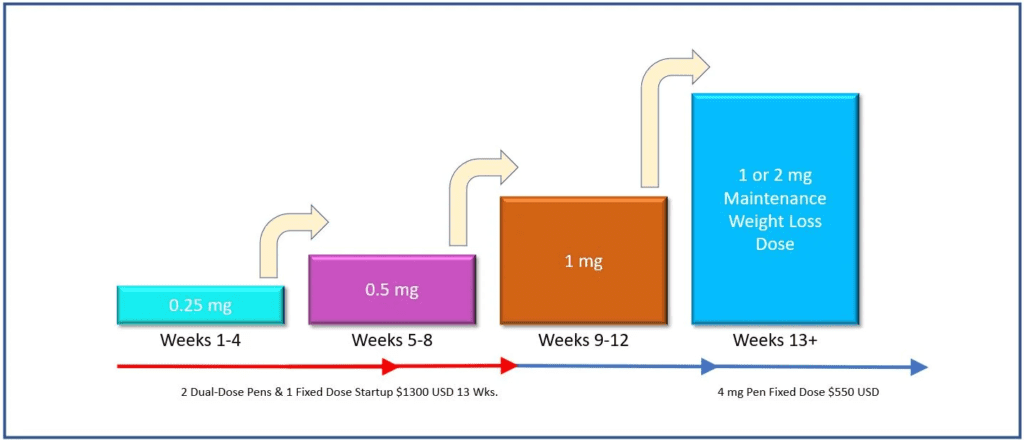
The following scheme has been proposed for the dosing of Ozempic, which, however, is primarily a starting point - it is important to have an individual approach to the dosing of each patient. [29]:
- Start with 0.25 mg/week for the first four weeks (one pen)
- Increase to 0.5 mg/week from week five to week eight (second pen)
- Increase to 1 mg/week after week nine (one 1 mg/dose pen every four weeks)
- If the effect is unsatisfactory after at least four weeks of 1 mg/week, the dose may be increased to 2 mg/week Ozempic.
Ozempic should be administered subcutaneously once a week, on the same day of the week. [5].
If a dose is missed, it should be taken within 5 days and then return to the regular intake. If the missed dose is not taken within 5 days, it is best to skip it and return to the regular intake.
How many clicks do I need to count to measure a specific dose from the Ozempic pen?
Sometimes a dose reduction may be necessary due to side effects or other reasons.
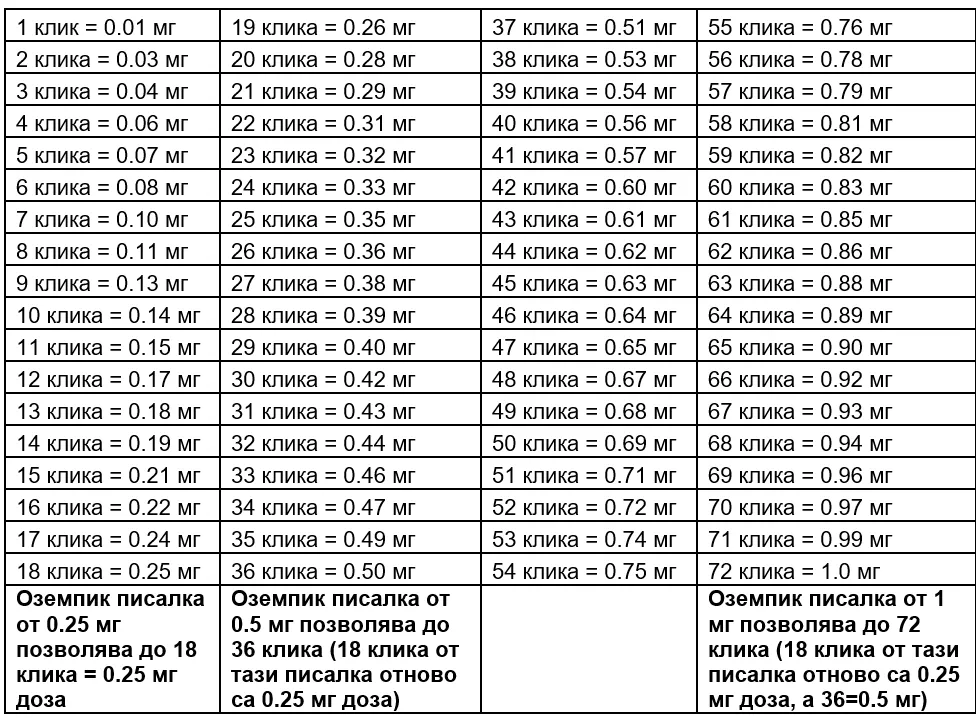
If a high-dose pen is available (e.g. 1 mg), but 0.25 or 0.5 mg needs to be inserted, this is entirely possible if we carefully count the clicks (ticks) of the dispenser when turning.
Then, with a pencil or pen, you can mark the place where the dose should be.
Unlike Wegovy, all Ozempic pens use the same mechanism, and each click on all of them equals the same dose:
- Ozempic 0.25 mg pen allows up to 18 clicks = 0.25 mg dose
- Ozempic 0.5 mg pen allows up to 36 clicks (18 clicks from this pen is a 0.25 mg dose)
- Ozempic 1 mg pen allows up to 72 clicks (18 clicks from this pen are a 0.25 mg dose, and 36=0.5 mg)
Where is Ozempic placed?
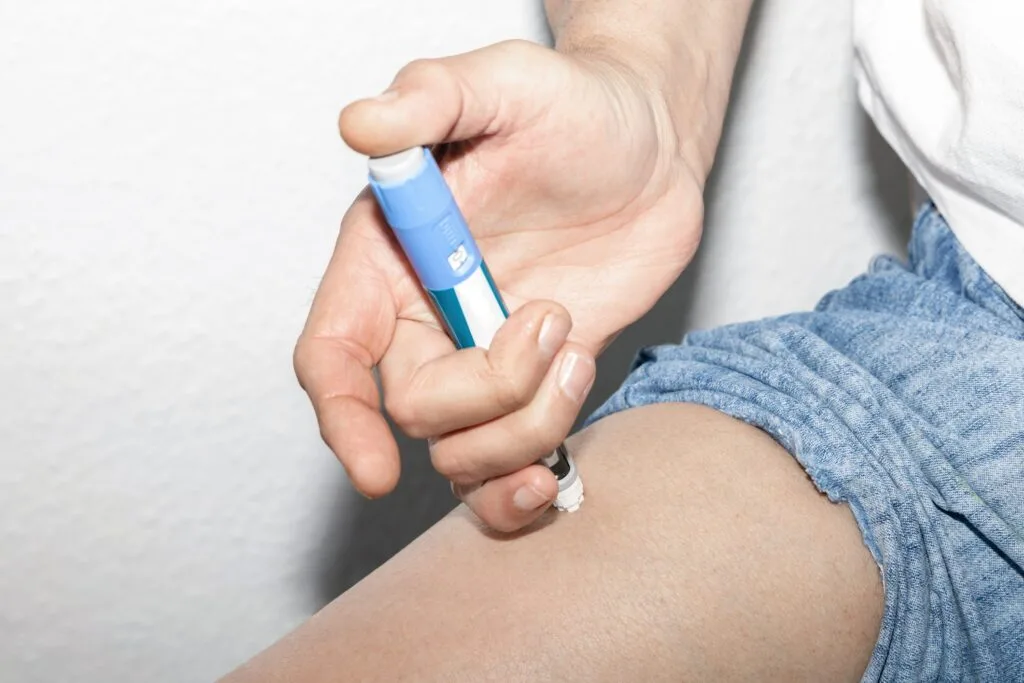
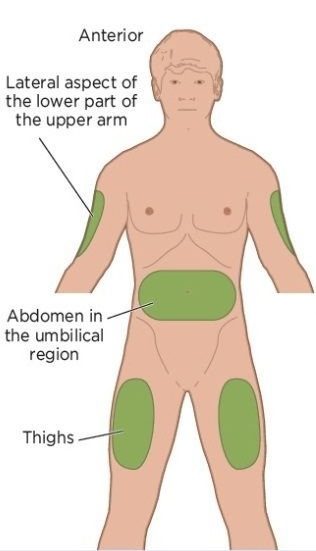
Ozempic can be injected into the abdomen (about 5cm to the left or right of the belly button), the upper back of the arm (between the shoulder and elbow), or the outer side of the thigh. [29].
The abdominal area is most preferred by patients as it is associated with the least pain.
Ozempic should not be placed in exactly the same place each time, as this may damage the subcutaneous fatty tissue and lead to aesthetic problems.
Therefore, patients usually inject Ozempic at different locations around their belly button (about 5 cm from the belly button).
Ozempic should not be applied to areas where the skin is irritated, epilated, red, broken, striated or otherwise damaged. This will increase the risk of local reactions and infections. [29].
How does Ozempic work?
For Ozempic to be successfully placed, patients need to have: [29]:
- Cotton or tampons
- Ethyl alcohol, mandatory 70%
- Sharps bin
Here are detailed instructions on how to use Ozempic, which you can pass on to your patients. [29]:
1) Preparation
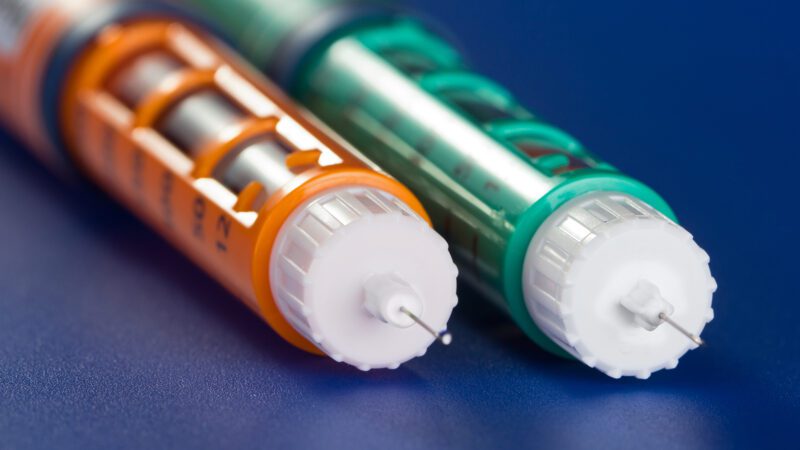
1. Open the box. Remove the pen and 1 of the 4 disposable needles.
2. Remove the pen cap and save it.
3. Check the solution: clear/transparent (may be slightly whitish); bubbles are OK. Cloudy, particulate or colored = unusable.
4. Remove the foil from the needle, screw it onto the pen. Remove the large and small caps; keep the large one.
2) Check – only when using the pen for the first time
5. Turn the dispenser until the symbol „:—“ appears instead of „0“.
6. Press the button: a drop should appear and the counter should return to „0“. If necessary, try again. 6 times. If it fails → the pen is defective.
3) Injection
7. Select a spot and disinfect with a swab/cotton swab. 70% alcohol/ethanol.
8. Set the desired dose (up to the maximum that the pen allows).
9. Insert the needle at a right angle (90°) all the way into the skin.
10. Press the button and hold for more than 7 seconds after the "click" without removing the needle.
4) After the injection
11. Remove the needle and press the site with a 70% ethanol swab. Do not massage.
12. Put it back the big cap on the needle, unscrew the needle and throw it away in a sharps container.
13. Replace the opaque cap on the pen and store as directed.
If a small ball-shaped bump forms immediately after the Ozempic injection, it is possible that the needle was not inserted all the way and the peptide was injected intradermally or subcutaneously.
This is not a problem and the ball will disperse within 24 hours.
Local skin reactions after injection are also possible.
They usually go away quickly and include complaints such as swelling, redness, bleeding, or pain.

How long can Ozempic be taken?
According to scientific research on the subject, Ozempic and Uegovi (2.4 mg/week semaglutide) have been tested for periods of over 2 years.
According to these studies, taking Ozempic for a period of 2 years is completely safe. [30], [31].
Studies report that the maximum effect in terms of weight loss is usually reached around week 60. [30], [31].
How do you stop Ozempic?
Although we have heard about all sorts of practices from patients and colleagues, Ozempic does not stop at a special scheme.
Semaglutide remains in the human body for over 5 weeks, and stopping it "all at once" does not lead to rebound.
In fact, what happens when Ozempic is stopped is a gradual return of appetite to its previous levels. There is no "rebound" effect where appetite becomes higher than before treatment.
Abruptly stopping Ozempic is also the method used by scientists in clinical trials of the drug. [23].
Due to the return of appetite after stopping Ozempic, weight gain and worsening blood sugar control are also possible., if the patient has not changed permanently their eating habits and lifestyle.
In order to achieve lasting change and maintain results after stopping treatment, it is crucial to conduct detailed consultation with a doctor - nutritionist.
Weight Loss with Ozempic – Opinions of Specialist Doctors:
„"When used as prescribed and under the supervision of a specialist, Ozempic is an effective tool for suppressing appetite and improving blood sugar control.".
The most common side effects can be controlled by proper dosing and controlling the rate of weight loss. There is currently no known risk to the thyroid gland.
It is important to carefully explain to all patients that there is a risk (1 in 10,000) to vision in people with a rare anatomical variation of the optic disc, especially in hypertensive patients, which in combination with the otherwise desired normalization of blood pressure can lead to NAION.
In most patients, Ozempic therapy is considered safe, but requires careful screening and continued monitoring by an experienced doctor to monitor changes in weight, abdominal circumference, muscle mass, etc. indicators„"„
– Dr. Dimitar Marinov
If you found this article helpful, feel free to follow me on social media for more evidence-based content.

12 thoughts on “Отслабване с Оземпик – ефективност, странични ефекти, цена и мнения на специалисти”
And can Ozempic also be prescribed to people who want to lose weight but don't have insulin resistance or diabetes?
For patients who do not have the above, but are overweight/obese, there is another medication that I can also prescribe – Wegovy. It contains exactly the same thing and is already available in some pharmacies.
Hello, how long should Ozempic be used?
I saw that it says 1- 4 weeks; 5- 8 weeks; 8- 13 weeks
Am I to understand that after that it should stop?
Thank you
Hello, this is the regimen to take until the maximum dose is reached. After that, the dose can be maintained for years to control blood sugar in diabetics, for example.
And how, is there a schedule for stopping Ozempic?
It is stopped only under medical supervision - at the individual discretion of the patient.
Hello, as a nutritionist, can you prescribe therapy with Ozempic?
Hello, I can prescribe Ozempic if the patient has the indications. Patients can contact me on 0896 779 770 to discuss the options in more detail.
Hello! Can I have a contact email?
Yes: dr.marinov.md@gmail.com